
Silent speech input
Speaking Without Sound
We developed a silent-speech input system using facial and head-motion signals and compared it with voice input and mid-air typing.
ACM CHI 2027 · Under review
DetailsHuman–computer interaction · Sensing · Extended reality
I develop and evaluate sensing-based interfaces for extended reality (XR), combining signal processing, machine learning, and interactive system design. My recent work includes silent speech input from facial and head motion, alongside ongoing research on EMG-based target selection. I am particularly interested in how input models can handle signal variability and generalize beyond the users and conditions seen during training.
Drawing on human factors and ergonomics, I connect system development with user studies to evaluate performance, workload, and usability. My broader research includes context-aware MR interfaces, input evaluation, and avatar-mediated communication.
I am a Research Assistant at Kangwon National University. I received my M.S. in Data Science from KAIST in 2026, advised by Shuping Xiong.
Silent speech input
We developed a silent-speech input system using facial and head-motion signals and compared it with voice input and mid-air typing.
ACM CHI 2027 · Under review
DetailsAdaptive MR interfaces
We compared four MR rendering methods, including pedestrian-aware adaptive transparency, to examine reading performance and pedestrian avoidance while walking.
International Journal of Human-Computer Interaction · Under review
Details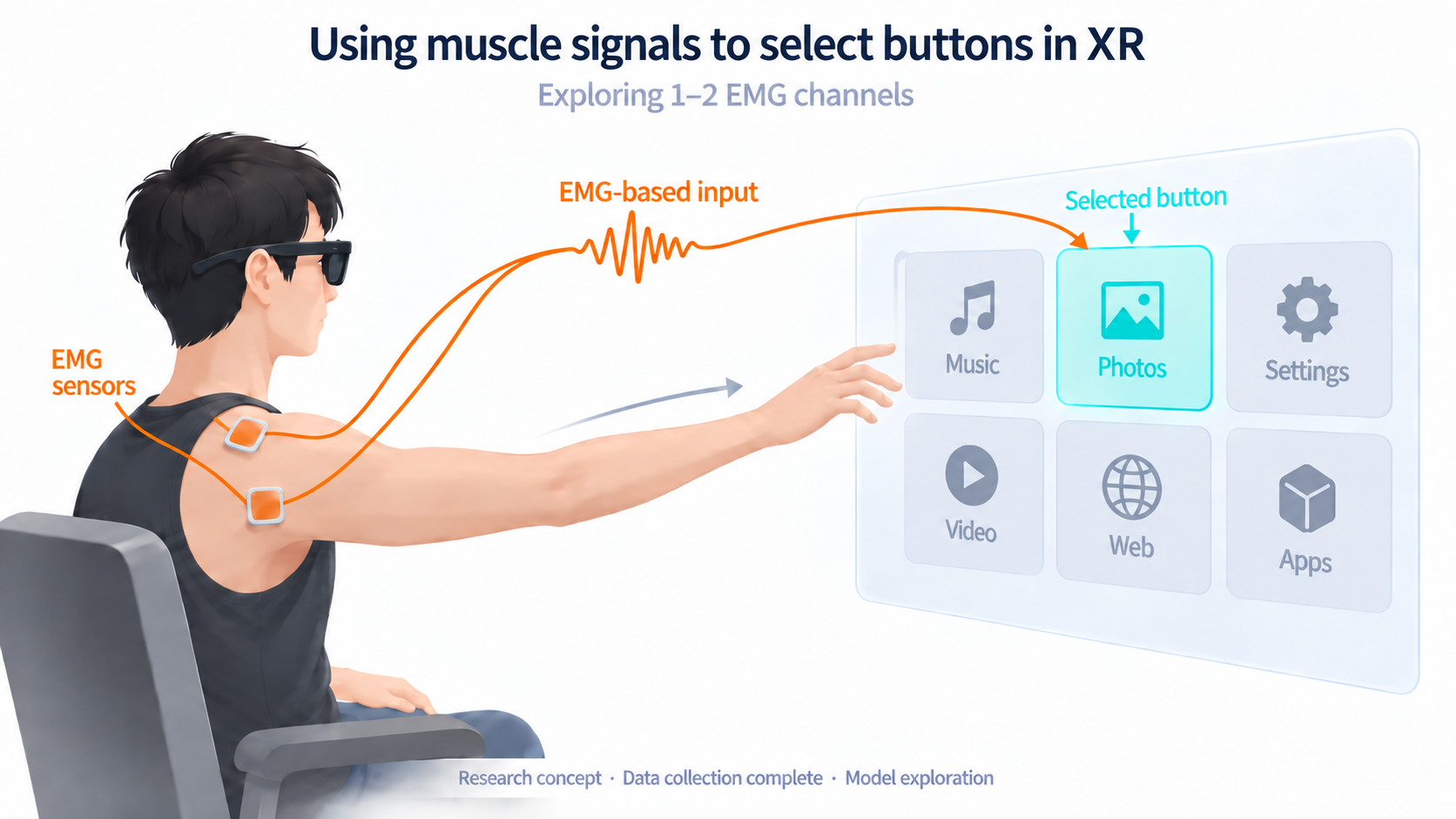
EMG-based input
This project explores whether one or two EMG channels can identify the target a user reaches toward, including target positions not seen during training.
Data collection complete · Signal analysis and modeling in progress
Project overview